Friday, September 5, 2008

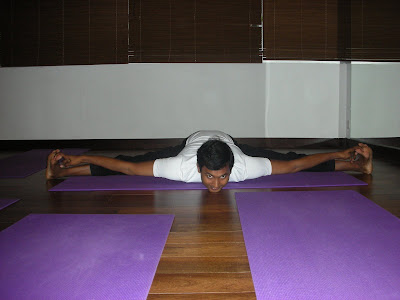
UPAVISHTAKONASANA :-


UPAVISHTAKONASANA :-

Upavishta means seated. Kona means an angle.

STEP BY STEP :-
1 Sit on the floor with the legs stretched straight in front.
2.Move the legs sidewaysone buy one and widenthe distance between them as far as you can. Keep the legs extended throughout and see that the back ofthe entire legs rests on the floor.
3.Catch the big toes between the respective thumbs and index and middle fingers.
4.Keep the spine erect and extend the rigs.Pull lthe diaphhragm up and hold the pose for a few seconds with deep breaths
5.Exhale, bend forward and rest the head on the floor. Extendthe neck and place the chin on the floor.
6.Then, clasp the feet with the hands and try to rest the chest on the floor. Stay int his position from 30 yo 60 seconds with normal breathing.
7.Inhale, raise the trunk off the floor and releas the hold on the feet, bring them together and relax.


8. Hold the left foot with both hands,exchale and rest the chin on the left knee.Inhale and raise the head and trunk.Now catch the right foot and with an exhalatin rest the chin ont the right knee. Inhale, raise the head and trunk, release the hands, bring the feet together and relax. EFFECTS :-

The asana stretches the hamstrings and helps the blood to circulate properly in the pelvic region and keeps it healthy. It prevents the development of hernia of which it can cure mild cases and relieves sciatic pains. Since the asna controls and regularises the menstrual flow and also stimulates the ovaries, it is a boo to women.





Wednesday, September 3, 2008

What Is Yoga And How It Works?


What Is Yoga And How It Works?
Yoga is an ancient word. It comes from Sanskrit, the most ancient languag of India, the origin of most of lthe Indian languages and related to Indo European languages such as Bengali, Hindi, Punjabi, Latin, Greek, German, Russiabn etc. The word yoga has two menaings in Sanskrit; the first comes from the root 'YUJIR' or 'Union', the second is derived from a different root 'yuja' which means 'samadhi' - the highest state of mind, the absolute knowledge and the final realization. These two are the most important meanings of the word yoga according to PANINI, the most well known Sanskrit grammarian.
Yoga is one of the six schools of Hindu philosophy, focusing on meditation as a path to self-knowledge and liberation. In India, Yoga is seen as a means to both physiological and spiritual mastery. Outside India, Yoga has become primarily associated with the practice of asanas (postures) of Hatha Yoga.Yoga used as a form of alternative medicine is a combination of breathing exercises, physical postures, and meditation, practiced for over 5,000 years and is the form of Yoga most widely known in the West.A committed practitioner of yoga is referred to as a yogi, yogin (masculine), or yogini (feminine). Yoga as a means of spiritual attainment is central to the dharmic religions family and has influenced other religious and spiritual practices throughout the world.

What Can You Achieve With Yoga Exercises?
Increasing Flexibility -
yoga has positions that act upon the various joints of the body including those joints that are never really on the radar screen let alone exercised.
Increasing lubrication
of the joints, ligaments and tendons - likewise, the well-researched yoga positions exercise the different tendons and ligaments of the body.
Surprisingly it has been found that the body which may have been quite rigid starts experiencing a remarkable flexibility in even those parts which have not been consciously work upon. Why? It is here that the remarkable research behind yoga positions proves its mettle. Seemingly unrelated non strenuous yoga positions act upon certain parts of the body in an interrelated manner. When done together, they work in harmony to create a situation where flexibility is attained relatively easily.
Massaging of ALL Organs of the Body -
yoga is perhaps the only form of activity which massages all the internal glands and organs of the body in a thorough manner, including those such as the prostate - that hardly get externally stimulated during our entire lifetime. Yoga acts in a wholesome manner on the various body parts. This stimulation and massage of the organs in turn benefits us by keeping away disease and providing a forewarning at the first possible instance of a likely onset of disease or disorder.
Complete Detoxification - by gently stretching muscles and joints as well as massaging the various organs, yoga ensures the optimum blood supply to various parts of the body. This helps in the flushing out of toxins from every nook and cranny as well as providing nourishment up to the last point. This leads to benefits such as delayed ageing, energy and a remarkable zest for life.
Excellent toning of the muscles - Muscles that have become flaccid, weak or sloth are stimulated repeatedly to shed excess flab and flaccidity.

BAKASANA


(bahk-AHS-anna) baka = crane
The body in this pose resembles that of a crane wading in a pool of water, hence the name.
Step by Step
1)Squat down from Tadasana with your inner feet a few inches apart. If it isn't possible to keep your heels on the floor, support them on a thickly folded blanket. Separate your knees wider than your hips and lean the torso forward, between the inner thighs. Stretch your arms forward, then bend your elbows, place your hands on the floor and the backs of the upper arms against the shins.
2)Snuggle your inner thighs against the sides of your torso, and your shins into your armpits, and slide the upper arms down as low onto the shins as possible. Lift up onto the balls of your feet and lean forward even more, taking the weight of your torso onto the backs of the upper arms. In Bakasana you consciously attempt to contract your front torso and round your back completely. To help yourself do this, keep your tailbone as close to your heels as possible.
3)With an exhalation, lean forward even more onto the backs of your upper arms, to the point where the balls of your feet leave the floor. Now your torso and legs are balanced on the backs of your upper arms. As a beginner at this pose, you might want to stop here, perched securely on the bent arms.
4)But if you are ready to go further, squeeze the legs against the arms, press the inner hands firmly to the floor and (with an inhalation) straighten the elbows. Seen from the side the arms are angled slightly forward relative to the floor. The inner knees should be glued to the outer arms, high up near the armpits. Keep the head in a neutral position with your eyes looking at the floor, or lift the head slightly, without compressing the back of the neck, and look forward.
5)Stay in the pose anywhere from 20 seconds to 1 minute. To release, exhale and slowly lower your feet to the floor, back into a squat.
EFFECTS:

This asana strengthens the arms and abdominal organs since the latter are contracted.By continued practice the lateral muscles of the avbdomen will develop will develop and the intestines will grow stronger.