Wednesday, September 10, 2008

DWI PADA KAOUNDINYASANA


DWI PADA KAOUNDINYASANA
Dwi Pada(dwi =two or both; pada=leg or foot) means both feet.
Koundinya was a sage belonging to the family of Vasistha and founded the Koundinya Gotra(sect). This asana is dedicated to him.
TECHINQUE
1. Perform Salamba Sirsansana .
2. Exhale and lower the legs straight together until they are parallel to the floor. Pause here and take a few breaths.
3. Exhale, turn the trunk slightly to the right and move both legs side ways to the right . Lower both legs together over the right arm so that the outer side of the left thigh above the knee rests on the back of the upper right arm as near the armpit as possible.
4. Balance and take a few breaths. Then exhale and firmly pressing down both palms to the floor, lift the head off the floor. Then raise the trunk and stretch the neck. This is the final position in which the legs will be in the air almost parallel to the floor, while due to the twist of lthe trunk, breathing will be fast. Balance as long as you can from 1o to 20 seconds. Greater pressure will be felt on the left shoulder and arm which are apparently free.
5. Bend the knees, rest the head on the floor and again go up to Salamba Sirsasana. Rest herer for a while land repeat the asana on the left side as described above, reading left for right and vice versa. Here the right thigfh will rest on the back of lthe lupper left arm. Stay for the same length of time on both sides. Go up to Sirsasana again.
6. To complete the pose, either lower the legs to the floor and relax or do Urdva dhanurasana and stand up. When one has mastered Viparita Chakrasana, this exercise is exhilarating after Urdhva Dhanurasana.
EFFECTS:
The pose tones the abdominal organs. The colon moves properly and toxins therein are eliminated. It requires experience to balance with the legs well Stretched. The spine will become more powerful.

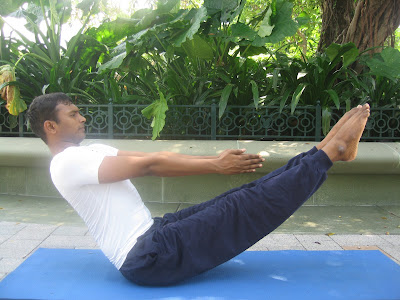
Tuesday, September 9, 2008

BETTER HEALTH AND FITNESS BY REGULAR PRACTICE OF YOGA THERAPY:


BETTER HEALTH AND FITNESS BY REGULAR PRACTICE OF YOGA THERAPY:
Yoga therapy is a westernized form of yoga that was developed specifically to assimilate yoga and conventional medicine in the treatment of the diseases and for the recreation of optimal health.
According to the practitioners of yoga therapy it is safer and more effective for the treatment of common medical conditions. It takes only individual health and physical limitations into account.
The main aim of yoga therapy is the mind/body integration, which strike into the normal healing properties of the body and helps to restore functions of your body and health.
Then practice yoga therapy for your better health and fitness. Strictly speaking yoga therapy is not an alternative medicine.
Its daily practice is often seen as a way of gaining control over your health.
Most of the practices of yoga therapy are used as complementary practices to conventional medicine.
Some of these practices are exercise, meditation and massage.
The main intent and goal of yoga therapy is the enlightenment of the spirit, but its aim includes physical health and well-being.
Yoga therapy consists of three basic parts of your body which work together.
Physical posture:
It helps to stretch and strengthen your muscles. It also improves your mobility, flexibility and balance. The proper posture enhances your body's natural functions of circulation, elimination, respiration, and digestion.
Breathing technique:
It mainly focuses on awareness of breath and helps promote calm, focus the mind and relieve stress and fatigue.
Relaxation technique:
It mainly helps you to recharge and ease tension.
Benefits of yoga therapy:
Yoga therapy shows positive results in treating depression.
Deep breathing associated with yoga is beneficial in controlling premature ventricular complexes.
Yoga therapy is beneficial in post-treating strategy, breast cancer and other survivors.
Yoga therapy shows significant benefits that includes emotional functions, fitness variations and psychological benefits. It also shows variations in tension, mood disturbances, cognitive function and gastrointestinal disturbances.
Practice of regular yoga exercise increases your body's ability in using antioxidants. This is beneficial in the prevention of cancer.
If you are a diabetic patient then yoga therapy improves nerve function and lower blood sugar.
If you are suffering from rheumatoid arthritis, the practice of yoga increases your hand grip strength.
Yoga helps in treating some problems like asthma, respiration problems, back pain, etc. it help in weight reduction.
Criticisms of yoga therapy:
The practice of yoga therapy is impossible if you have limited mobility and flexibility.
While attempting some of the postures of yoga without any pre-exercise preparation then there is a possibility of getting injured.
Before going to start a new treatment program, you must inform to your health care provider about any other fitness or alternative treatment programs that you have taken. Yoga therapy show promise in treating a number of conditions.

Saturday, September 6, 2008

TITTIBHASANA


TITTIBHASANA * Fire fly pose):

Type of pose:

Arm balance
Tittibha is an insect like a firefly.
After staying in this position for a few seconds, bend the legs at the knees,lower the body to the floor, release the legs from the arms, stretch them straight in front and rest forr a few seconds..
Benefits:

Strengthens the wrists, forearms and abdomen; stretches the hamstrings. In this asana the lungs and abdominal muscles are most tightly contracted. The spine is given a full forward stretch and the abdominal organs benefit quickly from the exercise.
Instructions:
1. Come in to a wide squat.
2. Bring your palms flat on the floor just under your feet.
3. Bend the elbows back as you would in
Chaturanga Dandasana.
4. Begin to shift your weight back to rest on your upper arms and bring the feet up off the floor.
5. Straighten the legs.
6. Begin to straighten the arms.
Beginners:

Like most arm balances, this is easier than it looks. For one thing, if you fall, you'll land on your butt instead of your head — as in some other poses! If you can lift the feet off of the floor but cannot straighten the legs, try crossing the feet at the ankles in front of you. Advanced:

Work on straightening your arms and legs.