Tuesday, March 10, 2009

Natarajasana


Pronunciation: not-ah-raj-AWS-anna
Definition:


Nata means actor or dancer and raja is king. Also called the Cosmic Dancer, Nataraja is another name for Shiva. Natarajasana is depicted in Indian iconography as a graceful figure with one leg lifted in dance, surrounded by a circle of flames. His dance symbolizes cosmic energy in its "five actions:" creation, maintenance, and destruction or re-absorption of the world, concealment of authentic being, and grace. Nataraja, or Shiva as the Cosmic Dancer, destroys and recreates the universe with each step. The Cosmic Dancer symbolizes the constant flow of energy and matter. It represents the destruction of the old self in preparation for the creation of a new one.Natarajasana is a balancing back bend which cultivates openheartedness and helps you uncover your inner radiance. As you stretch your whole body, you develop balance.
Technique:


Start in the mountain posture (Tadasana). Feel rooted in your left foot spreading your toes and keeping your weight equally distributed throughout the foot as you bend the right knee conveying all weight onto your left foot. Use your quadriceps muscle in your upper left leg to keep your left kneecap raised throughout the pose. Lift your right heel toward your right buttock as you bend the knee. Turn the right hand palm out with the thumb pointing to the behind you. Gaze at a point on the floor for balance. As you slowly inhale, grasp the right foot up and hold onto the foot or ankle with the right hand. To protect your lower back, try to lift your pubis toward your navel, and at the same time, extend your tailbone toward the floor. Square your hips to the front and slowly bend forward from the top of the left leg.You lift your right foot up, away from the floor, and back, away from your torso. Extend the right thigh behind you aligning it parallel to the floor. Stretch your left arm forward, in front of your torso, parallel to the floor with your fingers pointed forward and your palm facing down. As you do this, look straight ahead gazing at a steady point. The left thigh should be parallel to the floor with the left shin perpendicular to itThe action is having the left arm and leg up so that they form a bow behind the back. Play with the tension. As you extend your leg higher, Your body opens in the backbend and your chest may go toward the floor as part of the opening. Keep it aligned and graceful and hold for some long relaxed breaths. Release the pose, and repeat on the other side.


Beginner’s Tips:


Do the pose in stages and go further as you feel steady, moving onto the next step.Keep the foot that is being lifted flexed so you won’t have cramping in the back of the thigh. If you cannot easily reach your foot, simply use a belt or strap to hold it. If your balance is unsteady, try the pose facing the wall, standing a foot to a foot and a half away from it. Use your forward hand to touch the wall and assist your balance a bit. Don’t depend on the hand against the wall but gently touch it to provide another subtle anchor for your body.


Variation:


Some do the pose with the back extended leg virtually straight and held at the knee by the hand instead of at the foot. Another version, which is much harder. is to reach the arms upward by the ears with the elbows bent and grasp the foot. You can do this with one or both hands. There is a sort of hollow circle made by the arm or arms and the leg and back in this version which is quite beautiful


Benefits;


Great stretch for the shoulders, chest, thighs, groin, and abdomenLegs and ankles are strengthenedBalance improvesOpening to the shoulder and chestVertebral joints learn better performance for the bodyBuilds inner and outer steadinessImbues a psychological lift and opens the heart Contraindications:High or low blood pressureInjury to the legs, hips, low back, knees or shoulders, especially the shoulder capsule.If your shoulder is injured you can adapt by using a strap around the back foot so your shoulder doesn’t open so fully.

Friday, February 27, 2009

Yoga Helps Kids Find Balance in Their Lives


Yoga Helps Kids Find Balance in Their Lives
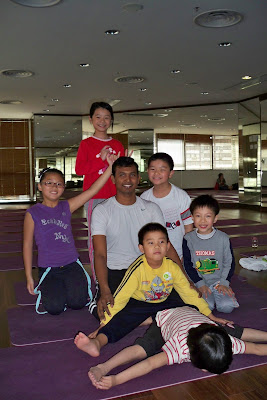
Children today are under a lot of stress. Homework, pressure to compete with other children, endless after-school activities, over-scheduling -- it all adds up. And just like their parents, kids today are turning to Yoga to help them relax.Teaching Yoga to children, I've seen how Yoga helps them develop better body awareness, self-control, flexibility and coordination. I've also seen how they can carry these skills beyond class and into their daily routines.Yoga has also been shown to help the hyperactive and attention-deficit child. These children crave movement and sensory/motor stimulus. Yoga helps channel these impulses in a positive way. Yoga poses that seem to work especially well are the warrior pose and tree pose. They help instill calm, confidence and balance. The trick is to get beyond just "doing" the postureYoga, adapted for pre-school children, develops body awareness, language, good listening skills, cooperation and powers of observation. It teaches pre-school children about nature, their environment and inspires their imaginations. It prepares them for breathing techniques used in yoga. They learn by playing, singing, moving and imitating. This is an ideal time for children to begin a yoga practice.Yoga with school aged children balances quiet and active poses with game playing, singing, storytelling, drawing, simple breath meditations and rest. Children can easily follow the teacher's instructions by learning the names of different body parts, their locations and function. As children learn the names of the postures and movements they develop a yoga vocabulary. They can use their yoga poses to play games, take on the qualities of different animals or use their imaginations to make up stories about animals on a farm, climbing a mountain or trekking through a jungle. They can each assume the role of leader and teach their classmates a yoga posture or breathing exercise. Their yoga improves very quickly.Yoga Therapy "empowers the soul to empower the body so that the child can grow with a feeling of wholeness" and reach her/his full potential. Early intervention enhances the healthy and natural development of infants and toddlers. However,it is never too late to reap the benefits of Yoga TherapyTeaching Yoga to children is challenging, exciting and rewarding. I am continually encouraged by the positive results, both physical and emotional, that I have observed in children who take yoga regularly. Children's spontaneity, innate joy and natural innocence and wisdom are always an inspiration....and we have lots of fun.

Sunday, February 22, 2009

Guidelines for Kids Yoga:


Guidelines for Kids Yoga:
I have gone over the guidelines and benefits of kids yoga in the article, Yoga for Kids Guidelines and Benefits, but am going to include this information in this article as well, so you can access it all in one place.
Children under 6 you can do up to 1 minute / exercise.
The total time for the kids yoga session can be up to 15 minutes.
Children 6 and above can do up to 1 1/2 minutes / exercise and the kids yoga session can last up to 25 minutes.
Encourage the child to do the pose correctly, along with the breathing, but don't force perfection. Use lots of positive reinforcement to help the child learn and improve.
Take frequent little breaks in between, during which encourage meditation and being still. Breaks after strenuous exercises is a must.
Always demonstrate the posture or exercise, rather than try to just explain it.
Use this technique even when trying to correct their poses.
Encourage the children to practice with their eyes closed when so indicated by the exercise.
This will teach them the profound art of looking and feeling what is happening within them.
Remember even kids need to warm-up before doing vigorous yoga.
Kids tummies should also not be full when doing yoga.
Never compare the children with each other.
Start them off with joining you towards the end of your yoga practice.
This is one of the best ways to inspire kids to start yoga.
Benefits of Childrens Yoga:
Builds their confidence and self-esteem.
Improves their powers of concentration and focus.
Develops their brain and intellect.
Excellent for their bodies and health. Promotes balance, flexibility, coordination and strength.
Helps them cope with stress and difficult emotions.
Develops their creativity and imagination.
Sharpens and expands their awareness.
Helps them develop calmness.
Tips to Help Teach Children Yoga:
The most important things to remember with kids yoga is to keep it fun, keep it open and keep it simple.
Below you will find a collection of kids yoga poses, demonstrated by my son Shivum when he was about four and a half.
The poses are for you to use in designing your yoga sets for the children.
There are many fun ways to encourage the children to learn and do yoga and here a few ideas for doing this.
Let your creative juices flow, I am certain many more good ideas will come to you as well.
Imaginative stories are some of the best ways to teach yoga to kids.
A trip through the jungle, etc, are a perfect way to incorporate doing the poses as you journey onwards.
Do cobra, bear, tree mountain, etc, as you come across these in your story.
Follow the leader is another great way to get kids to be creative and do the yoga poses.
You can lead and do your favorite poses, and then the kids can lead turn by turn doing theirs.
Yoga shows are great too and kids love nothing more than having your attention as they can put on a show of all the yoga they have learned.

Monday, January 26, 2009

YOGA FOR TEENAGER


A simple solution to beating exam stress, peer pressure, social anxiety and fear of being ridiculed, often faced by the urban teenager, lies in yogasana and pranayama techniques. These exercises if performed before and after study hours have tremendous benefits. Asanas that help include virasana, swastikasana, simhasana, shunmukhi mudra, viparitikarni mudra, sarvangasana, shirshasana, suptkonasana, nadishoddhana pranayama, sitkari, sheetali pranayama and trataka karma. Relaxation techniques such as shavasana, vamangasana, dakshinasana, yoga nidra, pranadharna and nispadbhava encourage the child to get to the root cause of his/her anxiety and worry. It can develop the child’s spontaneity and help him achieve a balanced and trained mind. Fear of failure can be overcome through the practice of marichiasana, pashasana, bharadvajasana, upavistakonasana, suptkurmasana and bhadkonasana, sahaj ujjayi pranayama, kagadivya pranayama, bhramari (internal pranayama). Mind, body and soul integration through rangachikitsa (colour therapy) helps expand consciousness. Surya namaskara channelises youthful energy and enhances the endocrine function to stimulate proper structural, physiological, psychological, emotional and spiritual growth. Extremes of behaviour (signs of the change in the endocrine system) can be regulated through inverted postures such as halasana, karnapidasana, viparitadandasana and sethubandhasana. Laziness and lethargy, a common feature of the growing child, can be addressed through janushirshasana, paschimatanasana, ardha baddha padma paschimauttanasana, trianga mukhaekpada paschimauttanasana and padmasana with gyan mudra. Poses that influence and boost the child’s confidence are lolasana, navasana, bhujapidsana, ashthavakrasana, tittibhasana, bakasana, garudasana, natrajasana, vrikshasana, urdhwahasta-ardha-padmasana, urdhwa prasarita ekpadasanan and vatayanasana. A crucial phase in life, adolescence is the golden stage which if nurtured well will lead to a healthy, developed individual. The writer is a yoga teacher and holistic healer

Wednesday, January 21, 2009

UTTANA PADASANA


UTTANA PADASANA
Lie flat on back, keeping the feet together and the knees tight. Breathe.
Exhale, and arch the back by lifting the chin and slide onto the back of the head. If necessary, use the hands at the side of the head to lift the head and bring it as far back as possible. Rest the arms at the sides. Breathe.
Stretch the back and on an exhalation, lift the legs to 45 or 50 degrees from the floor. Lift the arms, bringing them parallel to the floor, and join the palms. Both legs and arms should be straight.
Extend the ribs and breathe normally. The body is balanced only on the crown of the head and the buttocks.
Exhale, lowering the legs and arms to the floor. Straighten the neck, lower the back and relax.
Benefits: Tones and strengthens neck, back and abdominal muscles. The asana gives full exapansion to the chestwall and keeps the dorsal portion of the spine supple and healthy. It tones the neck and backand regulates the activity of the thyroids by ensuring their supply of healthy blood. The abdominal muscles are also stretched and strengthened.

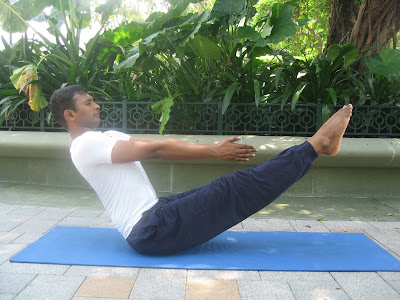
Navasana


Navasana

Translation: The Boat Pose
From a seated position bent the knees and tilt the upper body back.
Straighten the legs. Point the heels, toes or ball points of the toes.
Apply a little pressure inward so the legs stay together and lengthen the inner legs.
Raise the chest up and allow weight to fall upon the sacrum. Or balance on the very end of the tailbone. (The Coccyx)
Lengthen the torso.
Keep space around the front of the neck. Push through the top of the head to balance the energy that moves through the toes.
Benefits

This pose tones the abdominal muscles and some areas of the legs. The rectus abdominus raises the upper body and
Healing effects

This pose is good for lower back injuries because it strengthens the abdominals. However there are better and safer ways to strengthen the abdominals.

Sunday, December 28, 2008

SETU BANDASANA


SETU BANDASANA: SETU means bridge.BENIFITS:Bridge pose builds core and lower body strength, lengthens and strengthens the spine, energizes the body, and stimulates the endocrine and nervous systems.
TECHNIQUE; Lying on your back, bend both knees and place the feet flat on the floor hip width apart. Slide the arms alongside the body with the palms facing down. Interlock your fingers. and if you feel comfirt try to catch both ancles.
Press the feet into the floor, inhale and lift the hips up, rolling the spine off the floor. Lightly squeeze the knees together to keep the knees hip width apart.
Press down into the arms and shoulders to lift the chest up. Engage the legs, buttocks and mula bandha to lift the hips higher.slowly extend your both legs catch your back by your both hands.
Breathe and hold for 10-15 breaths.
To release: exhale fold your legs and slowly roll the spine back to the floor.

YOGA HEALTH SECRETS - BE HAPPY IN HEALTH


YOGA HEALTH SECRETS - BE HAPPY IN HEALTH
Health and happiness
Happiness is in the mind, and the mind is supported by the body – a healthy mind lives in a healthy body. Your happiness depends on your mind and it depends on your body. Without physical health you can't be completely happy, and without mental happiness you can't be completely healthy. Health is a positive state; not just the absence of a negative one. It's not only the absence of disease. For too long now traditional Western medicine has treated illness as only a disease: an enemy that attacks you and needs to be counter-attacked; but in reality it's nothing more than an imbalance in the natural harmony of body and mind. True healing means restoring that balance, and true health means keeping it.
Yoga means "to unify." It's the holistic approach to all aspects of life: physical, mental and spiritual. Yoga views the person as a whole; as a unique combination of body, mind and soul, and its techniques maintain that body-mind-soul harmony.
Physical health, relaxation

Stress relief

Stamina, vitality, zest for life

Clarity, concentration, memory

Motivation, willpower

Self-confidence and awareness

Creative insight

Love for all

Inner peace and happiness Prevention is better than cure
Nobody can deny that to prevent an illness is far better than to have to cure one. So it's important to live a life that prevents illness from developing, rather than to have to deal with it afterwards. We want to be healthy and stay that way.
How? There are 3 important points:
1. CleanlinessWhy should you not look after the inside of your body as much as you do the inside of your house or car? And a house or car is something you can actually replace! There's a saying that if you lose money you've lost nothing; if you lose your health you've lost something; and if you lose your peace of mind you've lost everything. "Health is wealth."
You can't be healthy without inner cleanliness. On the other hand, if you're clean internally, you won't even catch a cold.
2. Vitality
Vitality comes from the body's energy resources. We gain energy from the environment: from the sun, our food and water, and the air we breathe. That energy becomes vital energy in the body; the vitality that keeps us alive. The more vitality you have, the stronger you are, the greater your physical well-being, and the more inspired you'll feel.
3. Resistance
Resistance to disease is an automatic result of both cleanliness and vitality. If the blood is pure, the cells that fight disease can function freely, without being caught in a "traffic jam" of toxins and impurities. Resistance is an internal matter, and healing is also from within. Medicine only assists the body's natural internal resistance. Resistance also depends on your lifestyle. A well-controlled lifestyle gives physical health, mental peace and contentment.
But nowadays it's difficult to lead a healthy lifestyle – what with the pollution, the pressure of everyday life, and the lack of nourishing food and drink. Once I left a Big Mac for six months to see what it would look like. What did it look like after all that time? Exactly the same as when I bought it! Only it was hard, like plastic. Can you imagine what they put in those things. Much of the food we eat is sorely lacking in nutrition and vitality, even if it is supposedly fresh. On top of that, our ever-increasing materialistic outlook on life leaves us dull and uninspired.
So what's the answer?
Know yourself; take responsibility for your own health; be your own doctor. I'm not saying you're never going to need specialized medical treatment, but at least you can minimize the chance of needing it. "An apple a day," well you know the saying. What's the use of going to the doctor for something you can cure ten times easier yourself? Or even better, something you could have prevented yourself, with no extra demand on your time or your finances. And these are very simple things that you just need to be mindful of. But the point is that we're usually not mindful of them. Even the basic things like how to eat, how to breathe, even how to think – there's an art and science to every aspect of life that we should be aware of and make good use of.
Well, the good news is you can start from today. It's just a matter of knowing the things to do and doing them, because ultimately it's what we do in our lives that matters most. You have in your own hands the power to make your life better in every way: physically, mentally and spiritually. Yoga Health Secrets will show you how. In short, it is a simple, easy-to-follow guide of natural health for vitality, motivation, self-confidence and inspired happiness.

Monday, December 22, 2008

YOGA MUDRASANA


YOGA MUDRASANA:


First perfom BADDA PADMASASNABaddha means caught, restrained. In this position the hands are crossed at the back and the big toes are caught from behind. The body is caught between the crossed legs in front and the crossed hands behind, hence the name.Technique1. Sit in Padmasana.2. Exhale, swing the left arm back from the shoulders and bring the hand near the right hip. Catch the left big toe, hold the position and inhale.3. Similarly, with an exhalation, swing the right arm back from the shoulder, bring it near the left hip and catch the right big toe.4. If the toes are difficult to catch stretch the shoulders back, so that the shoulder-blades are brought near each other. A little practice in the swinging the arms back with an exhalation will enable one to catch the big toes.5. If the right foot is placed first over the left thigh and then the right big toe. If, on the other hand, the left foot is placed over the right thigh first and then the right foot over the left thing, catch the right big toe first and then the left big toe.Catch first the big toe of the foot which is uppermost.6. Throw the head as far back as possible and take a few deep breaths.7. Inhale deeply, and then with an exhalation bend the trunkforward from the hips and rest the head on the floor, without releasing the toes from the hand grip. Bending the head forward in Baddh Padmasana and touchingit on the floor is called YOGA MUDRASANA.8. Also move the head on to the right and left knees alternately with an exhalation. EFFECTS:Crossing the hands behind the back exp[ands the chest and increases the range of shoulder movements. Yoga Mudrasana intensifies the peristaltic activity and pushes down the accumulated waste matter in the colon and therby relieve constipation and increases digestive power.

DWI PADA VIPARITA DANDASANA


DWI PADA VIPARITA DANDASANA


Dwi Pada means both feet. Viparita means reverse or inverted. Danda means staff orrod, a symbol, authority or punishment as well as the bodyand its prostration. The Hindu devotee prostrates before the Lord lying flat upon thefloor, face downawards with hands outstretched. The Yogi on the other hand prostrates himsel in the graceful inverted arch described below.


Technique


1. Lie flat on theback .


2. Extend the arms over the head, bend the elbows and place the palms underneath the shoulders, fingers pionting the feet. Also bend and raise the knees, bring the feet near the hips and rest them on the floor.


3. Exhale and at the same time lift up the head and trunk and rest the crown of the head on the floor. Take a few breaths.


4. Exhale, extend the legs, straighten them one by one bearing the weight on the hands, head and neck.


5. Take the left hand off the floor and place it behind the head, resting the elbow on the floor. Take two breths.


6. Now remove the right hand from and place the elbow on the floor, move the hand behind the head, interlock the fingers and rest the cupped hands against the back of the head. This is the final postion. In it the head and the hands will be in the same position as in Salamba Sirsasana.


7. The diaphragm being contracted, breathing will be faast and short. Take a few breaths, exhale and raise the shoulders as high as you can a above the floor, as also the chest, trunk, hips, thighs and calves.Stretch the legs straight from the pelvis to the ankles. Dig the heels into the floor and stay in this position to your capacity from one to two minutes.


8. Move the feet towards the head, bend the knees, release the fingerlock, raise the head from the floor, lower the trunk and relax.


9. Tth neck, chest and shoulders should be fully extended and the pelvic region raised as high as possible above the floor. To start with the neck will not stay perpendicular th the floor as it should and there will e a tendency for lthe head ndforearms toslip away. So rest the feet against a wall and ask a friend to press down the elbows until the distance between the feet and the head on the floor is propertly adjusted while the spine and legs are fully extended.


EFFECTS: In this asana, the abdominal muscles are exercised and the sp[ine is toned. As the bending is more strenuous, the effect is correspondingly greater.

Thursday, December 11, 2008

Adho Mukha Vrksasana


Adho Mukha Vrksasana -

Full Arm Balance (Downward Facing Tree)Inversions are important because of the effect they have on the glands situated in the brain which controls growth and the health of the body. The inversions and their variations stimulate the blood supply to the cells of the brain. They help develop a balanced temperament and contentment. They help with memory loss
, weakness, uneasiness, brain fatigue and mental disorders such as depression and emotional instability. The lungs are expanded and develop resistance so that one can acclimatize to any weather condition. Blood hemoglobin increases.The spine becomes strong. Diseases of kidneys, bladder, displaced or prolapsed uterus, intestinal disorders, headaches complaints of nose and throat are alleviated. The muscular system of the abdomen and the legs are toned. The
shoulders, arms and wrists are strengthened.Pose Practice FOR BEGINNERS.tand in Tadasana (mountain pose). Bend forward and place the palms shoulder width apart, several inches away from a wall.
Keep arms fully stretched.
Walk back several steps.
Bend one knee and swing the other leg up straight towards the wall.
The other leg will follow. Balance.
Stay for a minute breathing normally and keeping the legs fully stretched up.
Lift the head and look at the floor.
Try the pose in the middle of the room after learning to balance near the wall.

Wednesday, December 10, 2008

YOGA ROLL LIVE IN EVERY MOVEMENT


YOGA ROLL LIVE IN EVERY MOVEMENT
When one of us decides to pursue the study of Yoga, we find ourselves living and learning Yoga every day. On or off the mat, Yoga students can apply their practice to the many lessons life has to offer. The result of all this learning, and applying Yogic principles to life, is a major leap in self-improvement.You can learn from your past, live the present moment in harmony, and plan your future, with an improved perspective of each. Past, present, and future are valuable, but each is important in a different way.Let's first address the past. Many people are "prisoners" to their past. When you look at past lessons, mistakes, and set-backs, each is as valuable as any form of higher education. This becomes life experience, and you should make the most of any form of education; otherwise you are wasting your life experiences, twice - first by learning them, and then later by regretting, blaming, and second guessing yourself. On top of this, you can create poor mental, physical, and spiritual health.This is the exact opposite from what you are taught in a Yoga class. Yoga teaches you to unify these components of health, and this will enable you to improve your entire being. Put past worries, adversity, and pains behind you.You can save them in a "mental file," much like a valuable book. This teaches you not to repeat the same mistake twice. Remember that the past is filled with accomplishments, too. If you can read these words, you must be accomplishing quite a bit.Be fair with yourself and try not to be so critical. Let go of guilt and forgive yourself for being human. If you start to sink into deep dark past regrets, practice pranayama; breath awareness is the key to bringing you into the present.
YOGA ROLL LIVEIN EVERY MOVEMENT
This is much similar to what you might do when holding an asana for an extended time during your Yoga practice. This will also allow you to focus on the most important time of all – the present moment.The present is the time for action, and you must be proactive in order to succeed in life. Good reactions will save your life, but proactive behavior requires planning, innovation, vision, and perseverance. You must focus on the present to see opportunities which are right in front of you.Life is filled with many obstacles and you have to be ready for the daily challenge. You cannot change the past, but you can change the present and future. Every successful person has faced criticism, failure, and self-doubt.When you let negative thoughts into your heart and mind, you cannot think clearly. You cannot act now, and this affects your ability to plan for the future. How can you visualize success, if you are letting fear and self-doubt control your life?Fill your mind with passion that motivates you to step forward and plan your future. When you meditate, take the time to visualize your success, achievements, and goals as vividly as possible. When you practice meditation and Yoga in this way, you will find yourself enjoying life, helping others, and on your path to success.

Tuesday, December 9, 2008

OMKARASANA:


OMKARASANA:
This asana is most precious and having spiritual values. Chanting of OMKARA is believed to clean body and mind. This asana is a symbolic representation to provide spiritual, physical and mental discipline.
Technique
1. Perform Eka pada sirsasana
2 . After performing Eka Pada sirsasana, stretched leg should be folded and locked just below the shoulder. The entire body balance should be on the palms. The body should be straight and erect.
3. Stay in this position for about 10 to 20 seconds with even breathing and slowly come back to the normal position. Perform apposite side same manner.
Therapeutic Advantages
1. As the name itself suggests, this exercise provides physical and mental discipline . This asana no only cures physical disorders but also cures mental disorders.
2. This asana helps to increase memory power and mental sharpness. Most useful for children and students.
3. It provides strength to the shoulder and tones up the entire physical structure of the body.

RAJAKAPOTASANA:


RAJAKAPOTASANA:

Raja kapota means the king of pigeons. This is a very attractive but difficult pose. The chest is pushed forward like that of a strutting pigeon, hence this name.

1. Lie full length on thefloor on the stomach, bend the elbows and place the palms on the floor on either side of the waist.
2. Exhale, lift the head and trunk up and back by stretching the arms fully, without moving the pubic region and the legs, Remain in this postion for a few seconds, breathing normally.
3. Exhale, bend the knees and lift the feet up. The body weight will be felt by the pelvic region and the thighs. Take a few breaths.
4. Taking pressure on the right hand, lift the left hand and with a fast and deep exhalation swing the left arm back from the shoulder and catch hold of the left knee-cap. Take a few breaths. Again with a fast and deep exhalaion, swing the right arm back from the shoulder and grip the right knee-cap with the right hand.
5. Raise the chest and using the hold on the knees as a lever stretch the spine and neck still further back unitl the head rests on the soles and heels. Keep the feet togheter and the kneers as close to each other as possible.
6. Maintain the pose as lobg as you can for about 15 seconds. As the spine and chest arte fully extended while the abdomen is pressed against the grougnd, breathing will be very fast and difficult and a stay of about 15 seconds will seem like an age. The pose closely resembles Lagu Vajrasana, the difference being that the body now rests on the pelovic region and the thinghs, instead of on the legs from the knees to the toes.
7. 7 Stretch the legs straight again. Let go of the knees and bring the palms in front on the floor one by one. If both hands are released simultaneously, due to the tension of the spine one is apt to fall on the face and hurt oneself. After resting the palms by one in front, rest the chest on the floor and relax.
8. If this is difficult, place the palms on the floor and rest the crown of the head on the feet.

EFFECTS:
In Kapotasana the lumbar region of the spine feels the stretch. In Rajakapotasana on the other hand, both the lumbar and the dorsal regions of the spine benefit by it. The neck and shoulder muscles are fullystretched and exercised.As the weight of the body falls on the pubic region, more blood circulates there so that the region is kept healthy. The abdominal organs are pressed against the floor and so are masssaged. The abdominal organs are pressed against the floor and so are massaged. The thyroids, parathyroids, adrenals and the gonads receive a copious and rich supply of blood and this ensures increaased vitality. The asana is recommended for disorders of the urinary system. Along with Kandasana and Supta Trivikramasana, Rajakapotasana is recommended for controlling sexual desire.

Wednesday, November 26, 2008

PARSVA BAKASANA


Also known as: Side Crane Pose
Type of pose: Arm balance
Benefits:
Strengthens the wrist, forearms and abdomen. Improves balance.
Instructions:
1. Come to a squatting position with the knees into the chest.
2. Come up on to the balls of your feet and bring your palms flat on the floor in front of you about shoulder's distance apart.
3. Keeping the palms in place, turn your knees to face the right side.
4. Start to lean forward, keeping the head lifted, and place your hips on top of the left arm and your knees on top of the right arm.
5. Take one foot and then the other off the floor so you come to balance with both feet up.
6. Come down and try the other side.
Beginners: Try lifting one foot up at a time to get a feel for how far forward you need to bring yourself. Do not let your head drop! This will cause you to tip forward and lose balance. Put a blanket in front of you so you won't be afraid of hitting your head if you fall. Everyone falls when learning this pose.
Advanced:
Try the following variations:
Straighten both legs, keeping the feet in line with the hips.
Straighten both legs, and move the right leg to the back (see photo).
Come down and this time center the thighs on the left arm bringing all your weight onto the left arm when you come up. Jump back to chaturanga.

Sunday, November 23, 2008

EKA PADA KOUNDINYASANA I


EKA PADA KOUNDINYASANA I
Eka means one. Pada means a leg or foot. Koundinya is the name of a sage.
1. Perform Salamba sirsasana.
2. Exhale, lower the legs staight together until they are parallel to the floor. Pause here and take a few breaths.
3. Exhale, bend the legs and move the left leg sideways to the right. Place the left leg over the back of the upper right arm so that the outer side of the left thigh above the kneerests as near the right armpit as possible. Take a few breaths and balance.
4. Stretch the left leg straight sideways and the right leg straight back Take two breaths.
5.
Exhale,raise the head above the floor, extend the arms and balance on the hands. Keep both legs straight and taut at the knees. This is the final positon. Remain in the pose as long as you can up to 10 to 30 seconds with normal breathing.
6. Bend both knees, exhale, rest the head on the flooor and again go up to Sirsasana. Rest here for some time with normal breathing.
7. Repeat the asana on the other side for the same length of time as above, rading left for right and vice versa. Here the right thigh wil rest on the back of the upper left arm and the left leg will be strecthed staight back. Then again go up to Srsasana as as stated in position 6.
8. To complete the pose, either lower the legs to the floor and relax, or do Urdhva Dhanurasana and stand up in Tadasana. When on has mastered Viparita Chakrasana, this exercie is exhilarating after Urdhva Dhanurasana.

EFFECTS :-
The pressure of lthe leg on the abdomen in this pose massages the abdominal organs. The spinal twist rejuvenates and strengthens the spine .The arms and neck grow powereful.

Friday, November 21, 2008

AKARNA DHANURASANA:


AKARNA DHANURASANA:

Karna means the ear. The prefix a expresses the sense of near to, towards. Dhanu means a bow. In this posture, the left foot is pulled up till the heel touches the ear as an archer pulls the bow-string, while the othe hand holds the right big toe, this leg lying straigh on the floor. In the second movemebt the raised leg is straightened until it is almost perpendicular,the big toe being held throughout by the hand like an extended bow.

The asana is given below in two movements.

1. Sit on the floor with the legs stretched straight in front.

2. Hold the right big toe between the right thumb and the index and middle fingers. Similarlyhold the left big toe.

3. Exhale,bend the left elbow and lift the left foot up by bending the knee. Take a breath. Now exhale and pull the left foot up unitl the heel is close to the left ear. At the same time draw the let arm back from the shoulder. D o not let go of the right big tow. Keep the right leg extended through out and see that the back of the entire leg rests on the floor. The extended right leg should not bend at the knee.

4. Hold tis position from 15 to 20 seconds with normal breathing This is the first movement.

5. Now exhale andstretch the left leg up vertically. Take a breath. Exhale, draw the leg further back until it touches the left ear. Continue to grip the toes of both feet and fully extend both legs Do not bend the at the knees. It takes fome time to learn to balance in this second movement. Remain in this postion from 10 to 15 seconds, breathing normally.

6. Repeat the pose on the right sede, pulling the right foot twoards the right ear and raising it up vericallynear the right ear, while keeping the left leg straight on the floor. Do not relax the hand grip of the toes. Maintain the position on bnoth sides for an equal length of time. Then release the hands and relax.

EFFECTS :-

The practice of this posture makes the leg muscles ver flexible. The abdominal muscles are contractd and this helps tomove the bowels. Minor deformities in the hip joints are adjusted. The lower porition of the spine is exercised. The pose is full of grace. It should be practised unitl it comes effortlessly andgives the appearance of a trained archer discharging arrows from his bow

Monday, November 10, 2008

How Yoga Calms the Mind and Body


How Yoga Calms the Mind and Body

What's the difference between a cheerleader and a yogi practicing backbends and splits? From a distance, the two would appear to be doing the same thing. But if you looked a bit closer, you might notice that the yogi is breathing more smoothly, slower, and more evenly. You might even observe that while the cheerleader is looking around, smiling at everyone, the yogi's face is relaxed and his or her gaze is focused. While externally the differences between the yogi and the cheerleader may seem slight, the internal differences are significant.

Most yoga classes in the West focus exclusively on asana, the physical postures of yoga. While it's a good thing to stretch and tone, it's an even better thing to stretch and tone while slowing down the breath and incorporating other yogic meditation techniques. One such technique is the use of drishti, focusing the gaze, which helps to quiet the mind. When the gaze is fixed on a single point, the mind is less likely to be distracted by thoughts provided by visual stimuli (the carpet in here is ugly . . . I can't believe that guy is wearing those pants...). These thoughts distract and pollute the mind, causing it to constantly churn and fluctuate.

Yoga is famous for its ability to heal and bring peace of mind. But how does the practice of yoga accomplish this?

There are two nervous systems in the human body: sympathetic and parasympathetic. The sympathetic, commonly known as the "fight or flight" system, causes the blood pressure to rise, the breath rate to quicken, and stress hormones to flood into the body. Historically, this occurred to prepare the body for fighting dangerous animals. But in today's world, we experience this response while we are sitting in traffic or feeling stressed at the office. When this system is overly stimulated, we can experience health consequences such as ulcers, migraines, and heart disease.

The parasympathetic nervous system lowers blood pressure and slows the pace of the breath. When the blood no longer has to rush to the muscles, it is free to travel to the digestive, reproductive, glandular, and immune systems - systems made up of organs that are more necessary to long-term survival. The body now has time to heal the damage accumulated during our daily battles. Studies have shown that long, deep breathing encourages the actions of the parasympathetic nervous system and allows relaxation and healing to occur. The yogi practices breathing meditations called pranayama, which encourage the actions of the parasympathetic nervous system.

So while the yogi and the cheerleader both gain strength and flexibility from practicing backbends and splits, the yogi is able to reap additional health rewards from the addition of pranayama. But even more is happening within the yogi. The yogi is working to calm the fluctuations of the mind.

Try this little exercise: take a break from reading this article and spend the next five minutes concentrating on the breath and nothing else.

You probably discovered that your mind wants to think about everything but the breath. Our minds have a tendency to wander, to disconnect from our bodies, to daydream and fret about the future, to reminisce and stew over the past. Humans have evolved the ability to automatically breathe even while sleeping. While breathing does not require conscious awareness, focusing your attention on your breath will force you to focus on what's happening right now, at this very moment. Focusing on your breath doesn't allow your conscious mind to drift away, but encourages it to stay connected in your body and in the now.

But why shouldn't we allow ourselves to daydream or reminisce, it seems harmless? Well, frequently when we are reminiscing about the good old times we begin fear to these events won't occur again. The more time we spend in reverie, the less open we are to the good things that are happening right now. Often, even when we are the midst of a good time, we begin to worry about it ending and start plotting to make it happen again. We miss out on embracing the moment fully while it is unfolding. And while having goals in life is a good thing, spending hours daydreaming won't get you any closer to making your dreams come true. Being lost in fantasy can often lead to disappointment when reality hits.

The quality of the breath reflects the quality of the mind. There is a connection between our mental, emotional, and psychological states and the pace and depth of our breath. For example, when we are frightened, we take short, quick, shallow breaths. When we are deeply relaxed or asleep, we take long, deep breaths.

While our mental state influences our breathing pattern, we can choose to change our breathing pattern and thereby change our mental state. When you relax and slow the pace of the breath, the pace of the mind is similarly calmed and quieted. Over time, you begin to act and think from a state of peace. The more time you spend in this place, the more likely you are to act with patience, understanding, and compassion.

The breath also helps us to stay connected to the present moment. Staying in the now frees us. We can move on from past grievances and sorrows and can view the world as it really is, without false expectations. We learn to accept ourselves and others as we and they currently are. Being in the moment allows you to be fully present when you spend time with the people you love.

Our mood is also affected by how we feel physically. Ever try to be friendly when you have a stomach ache? Asana helps to keep our muscles, joints, and fascia strong and flexible. The practice of asana also helps reduce blood pressure, stimulate the immune and glandular systems, reduce insomnia, and heal the body in innumerable other ways.

The simple practices of asana (yoga postures), pranayama (breathing), and drishti (focusing) lead the yoga practitioner to not only a state of optimal physical health, but to a state of peace. These practices help to connect you to the present moment, to others and to your true self.

Tuesday, October 28, 2008

SPIRITUAL YOGA


SPIRITUAL YOGA
The process of Self-purification is not the work of a moment, nor of a few months but of years—nay extending over a series of lives. The later a man begins the living of a higher life, the longer must be his period of probation, for he has to undo the effects of a long number of years spent in objects diametrically opposed to the real goal. The more strenuous one's efforts and the brighter the result of his work, the nearer he comes to the Threshold. If his aspiration is genuine—a settled conviction and not a sentimental flash of the moment—he transfers from one body to another the determination which finally leads him to the attainment of his desire.
—A Master of Wisdom
RAJA-YOGA:


the true system of developing psychic and spiritual powers and union with one's Higher Self—or the Supreme Spirit, as the profane express it. The exercise, regulation and concentration of thought. Raja-Yoga is oposed to Hatha Yoga, the physical or psycho-physiological training in asceticism.
Yoga, meditation, cosmic consciousness, the mystic experience—these and other equally great and sacred terms have made the headlines in newspapers and people are discussing glibly matters they know very little about. There is much misunderstanding, and confusion grows worse confounded as reports and photographs appear in the media. How incongruous to associate publicity with the practice of Yoga! We read of diplomas obtained after a few months' training, of assurances that the pursuit of Yoga will make no demands upon the practitioner, who need not change his ways and may continue to enjoy the "good" things of life. It is stated that it matters little or not at all why you want to go in for Yoga, or what mode of life is yours; if you take to Yoga you will achieve wonders.
And so Yoga is the fashion of the hour and people are taking to Yoga as they would take, let us say, to swimming or to playing golf; nay, worse still—to smoking or to drugs; overlooking altogether that spiritual Yoga is itself a way of life and demands severe self-discipline.
Broadly speaking it is first necessary to distinguish between Hatha Yoga and Raja Yoga. The former deals primarily with the body; the latter with the inner man. The one is physiological; the other moral, mental and spiritual. Hatha Yoga claims to establish health and to train the will. Raja Yoga is concerned with the control and purification of the mind and is rightly described thus by Damodar K. Mavalankar:
Raj-Yoga encourages no sham, requires no physical postures. It has to deal with the inner man whose sphere lies in the world of thought. To have the highest ideal placed before oneself and strive incessantly to rise up to it, is the only true concentration recognized by Esoteric Philosophy which deals with the inner world of noumena, not the outer shell of phenomena.
Were the advocates of Hatha Yoga to keep to their physiological exercises and their effects upon the body, the danger would not be so serious. But while teaching asana and pranayama, posture and breathing exercises, they promise the development of spiritual powers and the attainment of higher levels of consciousness. These are possible only through the cultivation of virtue, and the first step is a clean life.
Down the ages all the Great Teachers have stressed the need for purity, virtue, and righteousness. As stated by one of them: "Lead the life necessary for the acquisition of such knowledge and powers and Wisdom will come to you naturally." (The Secret Doctrine)
The leading of the life is indeed the sine qua non condition for obtaining Wisdom; for the latter springs from within or rather from above; it is the divine afflatus from the Spirit in Man and cannot descend and be made manifest except in those pure of heart.
The literal meaning of the word "yoga" is union, and true Yoga is union with the Divine. One must be misguided indeed to believe that the gifts of the Spirit are to be obtained without the purification of the human personality. Sanctity is the mark of the true Yogi, of the man who has attained union with the Divine.
In the Bhagavad-Gita Krishna gives two most beautiful and suggestive definitions of Yoga which at once place it in its right perspective, that of a spiritual science and an art of living:
Equal-mindedness is called Yoga (II, 48)Yoga is skill in the performance of action. (II, 50)
Yoga is thus the training of the mind and the right performance of action.
Patanjali's Yoga-Sutras is rightly considered the classic par excellence on Yoga, and modern yogis, genuine or otherwise, quote from it profusely. Most people, however, do not study the book themselves and are ignorant, or conveniently overlook, that Patanjali, like all spiritual Teachers, stresses the need for self-purification as the prelimary step. Yoga begins with a rigurous moral training, and this ethical preparation precedes the actual practice of concentration as a specialized technique of meditation.
In the Yoga-Sutras this preparation is described under two headings: the first is Yama and the second is Niyama. Let all those attracted to spiritual Yoga and desirous of taking it up carefully study and endeavour to practise the steps—five in number—given under Yama and Niyama.
Briefly stated, they are as follows:
Yama consists of ahimsa or non-injury; satya or truthfulness; asteya or integrity; brahmacharya or continence; and aparigraha or non-attachment to possessions.
Niyama comprises saucha, purity; santosa, contentment; tapas, mortification; svadhyaya, study; and Isvara pranidhana, devotion to Isvara or God.
Only when all these virtues have been practised with some degree of success can the next stage be entered upon without risk. The moral tone of the practitioner has been raised; his life has become one of temperance, virtue and purity; his character has been ennobled and purged of egotism; his life is one of service.
"Seek this wisdom by doing service, by strong search, by questions and by humility..." says Krishna in the Bhagavad-Gita. (IV, 34)
This ethical preparation alone entitles the aspirant to undertake the practice of concentration as a technical discipline. To ignore Yama and Niyama and begin with asana, bodily posture, and pranayama, control of breath, is not only wrong, but positively dangerous. Foolhardy is the one who dares to dabble in Yoga without the protective armour of purity."KNOWLEDGE MUST BE CAREFULLY OBTAINED WITH A PURE MOTIVE," says W. Q. Judge, and again, "Motive is highly important and must be examined and tested countless times." Therefore those who want to go in for Yoga must ask themselves the question: Why do I want to practise Yoga? They must be of pure heart and of unselfish motive, remembering the injunctions and the warnings given in all spiritual traditions. All strike the same note and say: "Be of clean heart before thou startest on thy journey." For it is a sacred journey indeed, a holy pilgrimage, that which leads to union with the Spirit. May we prepare ourselves to undertake the sacred journey to the abode of Light and Truth Eternal wherein dwell the true Yogis

Thursday, October 16, 2008

YOGA & Mental Health


YOGA & Mental Health;
Yoga can be viewed as a scientific system designed to purify the body and the mind from toxins accumulated due to poor lifestyle choices and negative thinking patterns. A system rooted in thousands of years of empirical reasoning and evidence of its results, the goal of all Yogic practices is not only to be free of mental illness, but to achieve a state of mind that rests in equanimity in the face of the tumultuous emotions, desires, and suffering that are to be found in this world.
The major aim of this website is to start a discussion between two sciences of the mind: psychology and Yoga. Its goal is to provide a forum for understanding in more depth and detail how Yoga works as a science unto itself and as a complement to western psychologies understanding of the mind.
Yoga and Mental Health provides information for Yoga practitioners, students and psychologists on how the science of Yoga may be beneficial in transforming mental illness into a lifelong path towards mental health and spiritual wellbeing.
Yoga Psychology - The Body-Mind Connection
Yoga psychology is as vast as the subject it seeks to know and understand, the mind itself. Yoga psychology is the study of 'mind' and consciousness. When we study yoga psychology, we deeply and experientially explore our body-mind connection and work towards integration.
Understanding the mind is the first step to harnessing its awesome creative force for higher living.
Psychology asks 'what is a mind', a question that philosophers and scientists have been struggling with for millennia. Many theories have evolved, from the materialistic belief that mind is purely a component of the physical brain, to the transpersonal, esoteric belief, that the mind is an emanation of consciousness and therefore exists in every cell of the being.
Yoga psychology is the science of investigating the mind through yogic and meditative processes. The aim is not to intellectualize what a mind is, but to directly observe and cognize the mind; to have an experience of mind.

The investigative tools of yoga psychology are one's own awareness and the techniques of meditation.
Yoga psychology is the doorway to deeper self-knowledge. It teaches us to discipline and creatively channel the mind's power for higher purpose.
Yoga Psychology, body and mind are viewed as a single, indivisible unit.
The physical body is the gross aspect of the body-mind, and the mind is the subtle aspect. They are inseparable; therefore improving the mind also improves the condition of the body and vice versa.
In yoga and tantra, mind is viewed as a complex energetic process that deals with all aspects of knowing and knowledge, with the development of the individual personality (or ego), and with the expression of the personality.
Yoga psychology challenges us to take a more conscious role in developing our hearts and minds, in seeing the body-mind connection, and the connection between our individual selves and the greater universe.
The Origins of Yoga Psychology
The origins of yoga psychology and all yogic and tantric knowledge derive from the vast body of knowledge of Indian philosophy.
The origins of yoga psychology and yoga philosophy are intrinsically linked because in India mind and body are viewed holistically, as a single, indivisible body-mind in the same way that structure and function cannot be separated. The physical body is the gross aspect of the body-mind and the mind is the subtle aspect. To work on one is to work on the other.
Mind is an energetic process that deals with all aspects of knowing and knowledge, with the development of an individual personality or ego, and with all forms of expression of the personality. The mind is a tool for the existence and function of an embodied individual consciousness within the limits of time and space; to think, feel, emote, desire, remember, visualize and create.
Yoga psychology in its purest form is the use of meditation techniques, derived from yogic and tantric sources, to view all its processes objectively. Once we can see the mind we can work with and cultivate the mind for higher living.

The theories of what a mind is are found in related philosophies, particularly of Samkhya and Vedanta, part of classical Indian philosophy.
We can find the most refined explanations of the process of Yoga Psychology in the Raja Yoga Sutras of Patanjali. Here, mind is termed 'chitta', and yoga is defined as 'the process that blocks the patterns and functions of the mind, the chitta vrittis'. Blocking the chitta vrittis allows awareness to separate from its false identification with the body-mind and to re-identify with its true nature, the highest Self. This process is called union of individual consciousness with universal consciousness.
The patterns or modifications of mind, the vrittis, trap awareness in 'normal' unenlightened states of being. They keep us in small, limited states of being and awareness. Yoga psychology allows us to realize that we are trapped, how we are trapped, and gives us the tools for self-liberation.
The theory that underlies yoga psychology, the definition of what mind is, and an explanation of the organs of this mind is found in Samkhya, which describes the structure of the mind and how the parts function.
Vedanta adds to yoga psychology through its description of mind as sheaths, called the mental sheath (manomaya kosha) and the intelligence sheath (vijnanamaya kosha). These sheaths cover the atman, the spirit or individual consciousness.
In Tantra, mind is viewed as a mighty power that can be awakened to its full potential by the powerful practices of hatha yoga, mantra yoga and kundalini yoga. In Tantra, mental force (chitta shakti) is described as flowing in a channel (ida nadi), which runs along the spine and connects the chakras. In Tantra, mind as a whole is controlled by the chakra at the eyebrow centre, called the third eye (ajna chakra). All the other chakras control an aspect of the mind except the chakra at the crown of the head (sahasrara chakra) which is outside time and space and which is the seat of consciousness.

The origins of yoga psychology theory can also be found in Ayurveda, the traditional medicine of India, in particular the study of mental illness. Yoga Therapy borrows heavily from Ayurveda, Tantra, Vedanta and Samkhya.